Antenatal Sonography Toolkit
Objective, defensible assurance on fetal growth scan accuracy
- Live in an NHS foundation trust
- De-identified at source
- Case-mix adjusted for fairness
The AST gives maternity leaders clear, objective assurance on fetal growth scan accuracy. It is a low cost, low burden, quality improvement tool that strengthens safety assurance and supports staff through constructive, non punitive feedback.
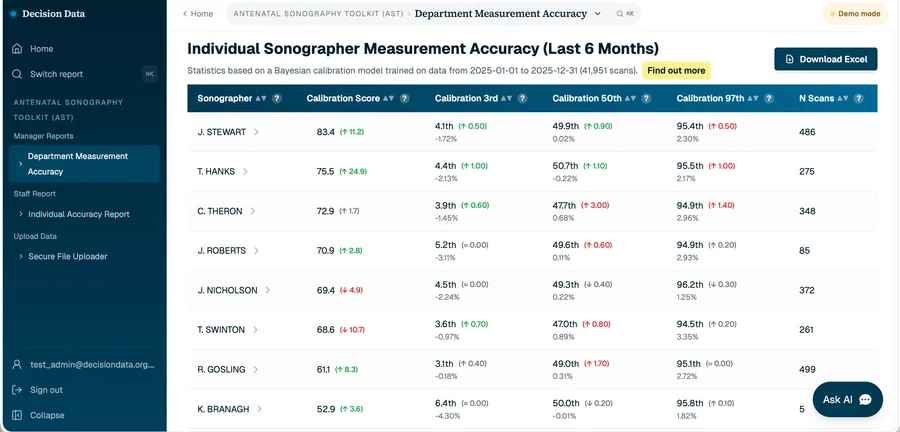
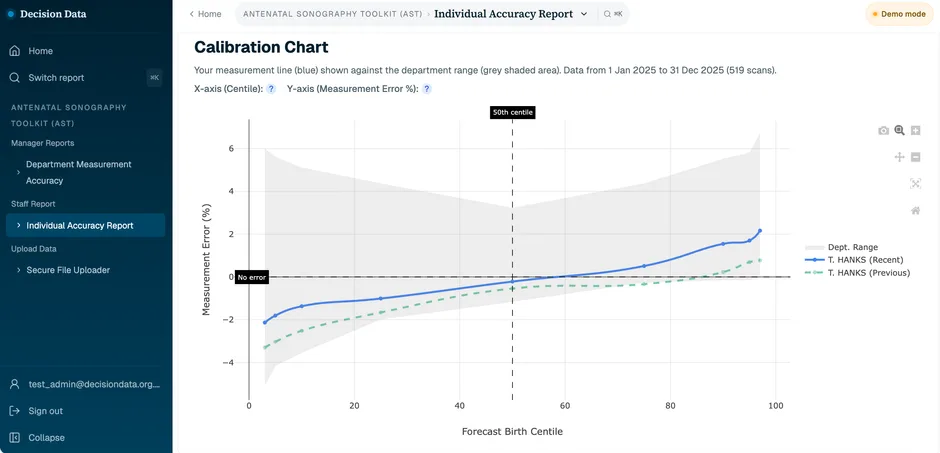
From subjective audit to objective assurance
Growth-scan accuracy drives major decisions, yet most departments still can't measure it fairly. The AST changes that.
Manual, retrospective audit
- No fair, objective measure of accuracy
- Variation between clinicians stays hidden
- Slow, manual and hard to defend to the board
- Feedback can feel like a judgement
Data-driven benchmarking
- An objective measure of growth-scan accuracy
- Case-mix adjusted, so it's fair to everyone
- Board-ready assurance for MIS, CQC and Saving Babies' Lives
- Quarterly, confidential, supportive feedback
Assurance you can act on and defend
Evidence you can take to the board
Board-ready metrics on growth scan accuracy that strengthen Maternity Incentive Scheme, CQC and Saving Babies' Lives v3 assurance, shifting from reactive, subjective audit to proactive, evidence-based control.
A clearer view of avoidable harm
By measuring where growth scans over- and under-estimate, the AST surfaces the patterns behind missed fetal growth restriction and false-positive SGA/LGA diagnoses, showing where unnecessary interventions, follow-ups and family anxiety might be reduced.
Fairer, more consistent care
Case-mix and demographic adjustment surfaces unwarranted variation and supports inequalities work, so similar pregnancies receive similarly reliable assessment.
Supportive by design
Feedback is quarterly, confidential and non-punitive, designed to support clinician confidence and calibration rather than add pressure.
From data to clinical insight
- 01
Upload securely
A nominated clinical lead uploads a routine data extract. It is de-identified and encrypted in the browser before it ever leaves your network.
- 02
We analyse
We combine the data and apply case-mix-adjusted statistical modelling to measure accuracy and the variation around it.
- 03
You decide
Clear quarterly reports and confidential, non-punitive feedback your whole team can read and act on.

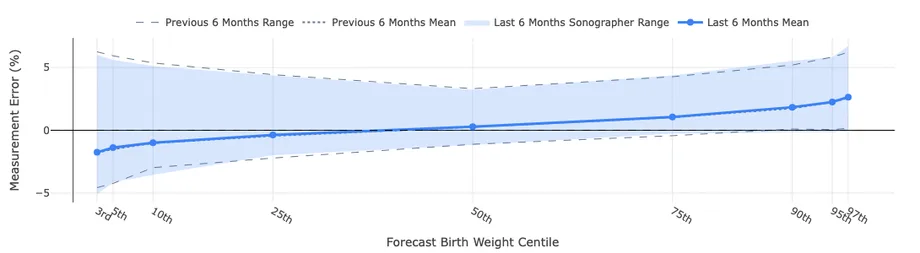
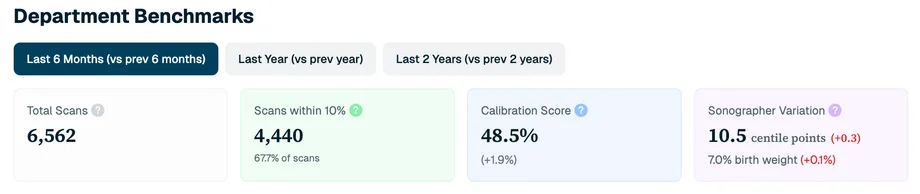
Case-mix adjusted, so feedback is fair
Comparing raw forecasts to birthweights is misleading, because clinicians scan different case mixes. A Bayesian hierarchical model adjusts for the case-mix factors that affect the forecast-to-birthweight relationship, so a complex caseload never makes a clinician look less accurate. Because results are case-mix adjusted, the feedback supports a positive learning culture.
Calibration score
0 to 100 · higher is betterHow closely the department's forecasts match actual birthweight, after case-mix adjustment.
Clinician variation
centile pts · lower is betterThe spread between the most conservative and most liberal operators, the variation we aim to narrow.
Low burden by design
Almost everything happens on our side. From your team we need three small things.
- 01
About 30 minutes a quarter
A nominated clinical lead uploads a routine, de-identified data extract once each quarter.
- 02
A short briefing
Brief participating clinicians using materials we provide.
- 03
Three signatures
Senior sign-off on the Software Services, Data Processing and Clinical agreements, with your IG team reviewing our governance pack.
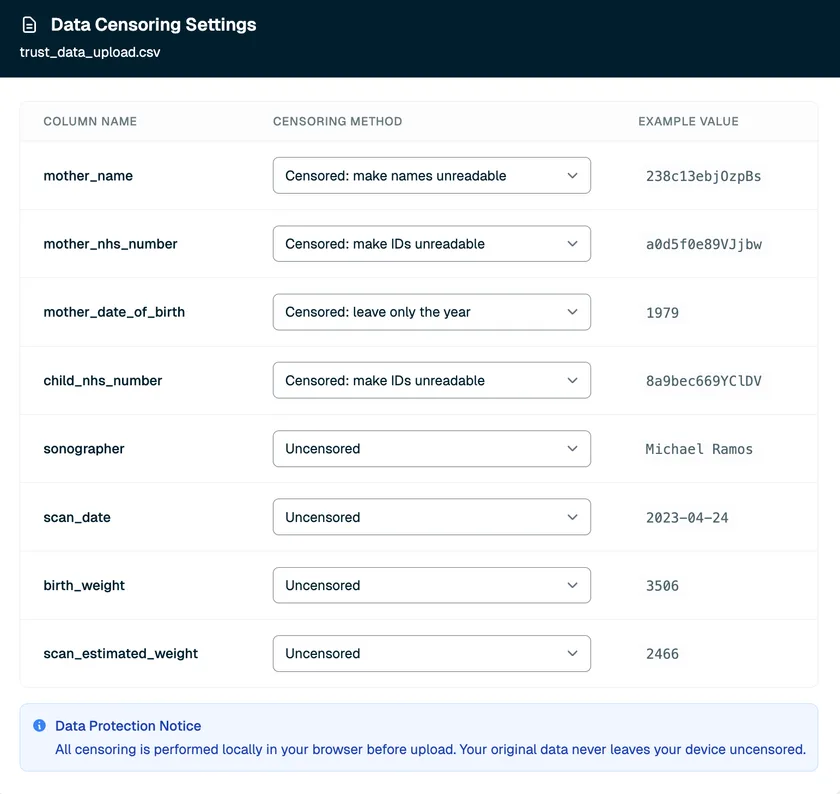
Everything else, modelling, reports, dashboards, learning notes and training, sits with us. Data is de-identified in your browser before it ever leaves you, so no patient-identifiable data reaches us.